Electrical Preventive Maintenance Checklist for Manufacturing Plants
Summary
An electrical preventive maintenance checklist for manufacturing plants: what to inspect, test and tighten, and how often under NFPA 70B and CSA Z463.
- Written by
- Tyler Weiss
- Published

Last updated: November 13, 2026
An electrical preventive maintenance checklist for a manufacturing plant covers four things: keep electrical equipment clean, cool, dry and tight. In practice that means an infrared scan of all distribution equipment every year, visual inspections of switchgear, transformers and grounding every year, and cleaning, torque checks, breaker testing and insulation testing on a three-to-five-year cycle, more often for equipment in poor condition or harsh environments. Those are the intervals in NFPA 70B, the Standard for Electrical Equipment Maintenance.
The payoff is real. HSB Canada, the equipment breakdown insurer, says more than two-thirds of electrical system failures can be prevented by a routine preventive maintenance program, and that studies show components outside a scheduled program fail at three times the rate of those inside one. This checklist is written for plant and maintenance managers in Ontario. Charged Electric, a licensed electrical contractor in New Hamburg, runs electrical preventative maintenance programs for manufacturing plants, food processors and warehouses across Southwestern Ontario and the GTA.
The four rules of electrical maintenance
HSB's recommended practice boils electrical maintenance down to four rules. Every item on the checklist below serves one of them.
Rule | Why it matters | What it looks like on the floor |
|---|---|---|
Clean | Dust and dirt trap heat, track across insulation and cause nuisance trips | Electrical rooms kept clear, never used for storage, gear vacuumed during shutdowns |
Cool | Conductors and devices are rated for a maximum heat load; exceed it and equipment life shortens | Vents and filters clear, enclosure and room fans working, no heat sources parked against gear |
Dry | Moisture causes corrosion, tracking and flashover | Roof leaks and condensation found and fixed, enclosure tops checked for water, seals and gaskets intact |
Tight | Loose connections are the most common cause of electrical equipment failure | Connections torqued to the manufacturer's specification, verified by infrared scans |
HSB singles out the last one: the most common source of electrical equipment failure is loose connections, and infrared imaging is an effective way to find them.

How often: what NFPA 70B and CSA Z463 say
There is no single schedule for every plant, because the right interval depends on the condition of the equipment. Two standards and one insurer guideline set the framework.
NFPA 70B. The 2023 edition turned NFPA 70B from a recommended practice into a standard. Its maintenance interval table rates each piece of equipment in one of three conditions, broadly good (Condition 1), fair (Condition 2) and poor (Condition 3), based on its physical condition, its environment and its maintenance history. Equipment that has missed maintenance cycles or had a change in operation can fall into Condition 3. Each task then gets an interval for each condition.
CSA Z463. In Canada, CSA Z463 is the standard for maintenance of electrical systems. The current edition is CSA Z463:24. It takes a risk-based approach, so frequency is set by how critical each piece of equipment is, the environment it works in and what earlier maintenance found.
HSB Canada. As a minimum, HSB recommends electrical preventive maintenance at least every three years, with more frequent maintenance in harsh environments with moisture or dust, for equipment that runs intermittently, and for equipment critical to a key process.
NFPA 70B maintenance intervals for common plant equipment
Equipment and task | Condition 1 | Condition 2 | Condition 3 |
|---|---|---|---|
Infrared thermography, all equipment | 12 months | 12 months | 6 months |
Switchgear, visual inspection | 12 months | 12 months | 6 months |
Transformers, visual inspection | 12 months | 12 months | 6 months |
Grounding and bonding, visual inspection | 12 months | 12 months | 6 months |
GFCIs and cable trays, visual inspection | 12 months | 12 months | 6 months |
Switchgear, panelboards, MCCs, breakers and switches: cleaning, servicing and electrical testing | 60 months | 36 months | 12 months |
Transformers, cables and motors: cleaning and electrical testing | 60 months | 36 months | 12 months |
Electromechanical protective relays: inspection and testing | 36 months | 24 months | 12 months |
UPS systems, visual inspection | 6 months | 3 months | 1 month |
Intervals summarized from NFPA 70B's maintenance interval table. Manufacturer instructions and the equipment's own history can call for shorter intervals.
Two things stand out. First, infrared scans and visual inspections happen every year no matter what condition the equipment is in. Second, the hands-on, de-energized work stretches to five years only for equipment in good condition. Gear that has been neglected or shows problems drops to a yearly cycle until it earns its way back.
The electrical preventive maintenance checklist
Use this as a working checklist. Plant staff can handle the walk-through items. Anything that involves opening energized equipment, testing or torquing connections is work for a licensed electrical contractor with the right safety procedures.
Every shift or weekly: walk-through by plant staff
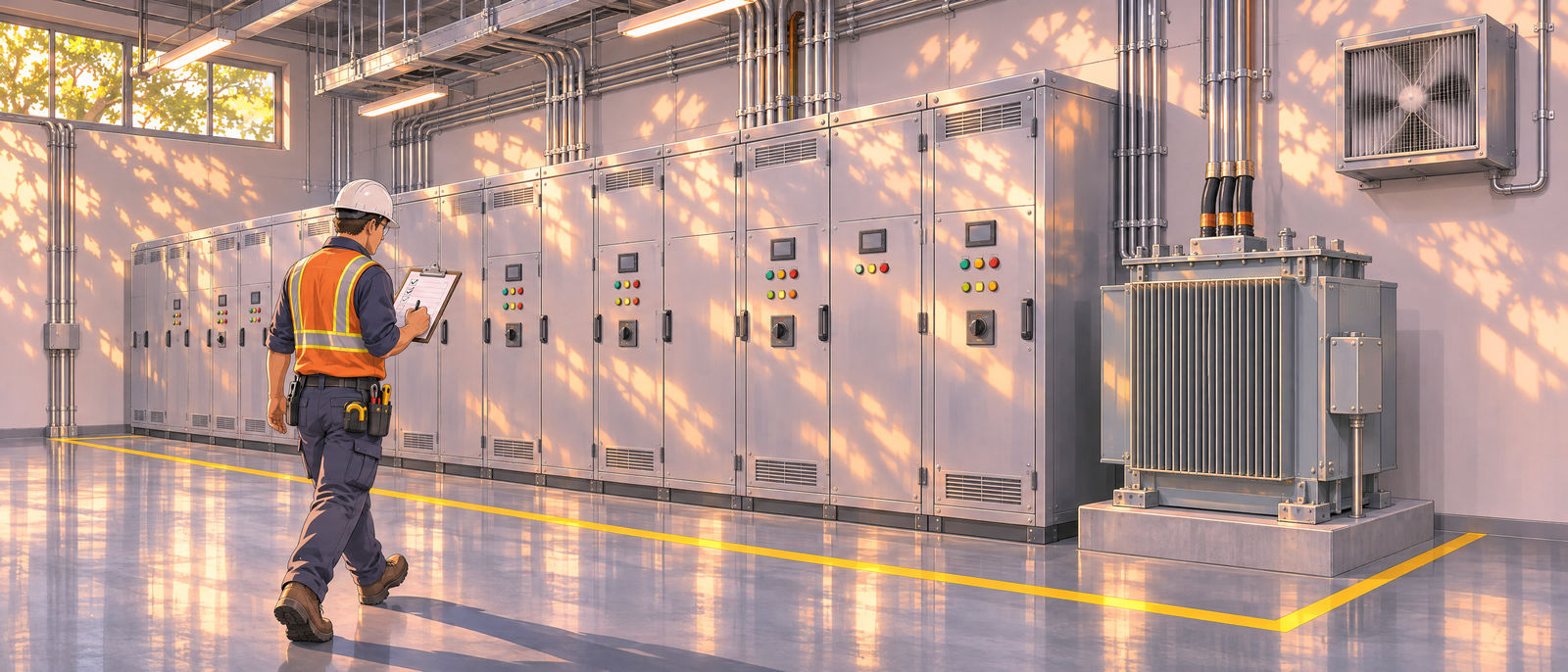
Electrical rooms clean, doors closed and marked, and nothing stored in them
No water on the floor, on enclosure tops or around conduit entries
Enclosure fans running and filters not visibly clogged
No unusual hum, buzzing, burning smell or discoloured enclosure surfaces
Drive and motor fault alarms reviewed and repeat faults logged
Panel covers and dead fronts all in place, with no missing knockouts
Monthly
Emergency lighting tested and logged, as required for the monthly and annual emergency lighting tests under the Ontario Fire Code
Stationary batteries and chargers: terminals clean and tight, electrolyte level checked where applicable, charger vents clear (HSB recommends these battery and charger checks monthly)
UPS alarms and status checked, and the visual inspection done monthly for any UPS in poor condition
Every 6 to 12 months
Infrared scan of all distribution equipment under load: switchgear, panelboards, MCCs, splitters, disconnects, transformers and motor connections. See what an electrical thermal imaging scan finds
Visual inspection of switchgear, substations and transformers: signs of overheating, tracking, corrosion, oil leaks on oil-filled units, damaged insulators
Grounding and bonding: connections visible and intact, no corrosion at ground bars and bonding jumpers
GFCIs tested, and cable trays checked for damage, overloading and debris
Previous findings closed out and confirmed fixed on the follow-up scan
Every 1 to 5 years, by equipment condition (de-energized, in a planned shutdown)

Switchgear and panelboards: vacuum clean (HSB advises against compressed air, which can drive dust into insulation), inspect insulators and barriers, torque connections to the manufacturer's specification, check heaters and seals
Circuit breakers: clean housings, exercise the mechanism, and trip test larger molded-case breakers. HSB recommends electrical trip testing for breakers rated 225 amps and above, following NEMA AB 4
Motor control centres: clean buckets, inspect stabs and contactors, test overload relays, torque terminations
Transformers: clean, inspect connections and cooling, and test windings and insulation. Oil-filled units get oil sampling and testing
Power cables: insulation resistance testing on feeders and critical motor circuits, with results trended against the last test
Motors and drives: connections, cooling paths, bearings and insulation resistance on motors; drive fans, filters, DC bus capacitors and fault logs on VFDs
Protective relays: inspect and test electromechanical relays on a shorter cycle than solid-state units
Disconnect switches: inspect, clean, lubricate as specified and test contact resistance on larger switches

Plan around production, not the other way around
A preventive maintenance program only works if production can live with it. The way to do that is to split the checklist by what needs a shutdown and what does not.
Done while running: infrared scans (which need equipment under load anyway), visual inspections from outside the enclosure, battery and UPS checks, emergency lighting tests and fault log reviews.
Done de-energized: cleaning, torque checks, breaker and relay testing, insulation resistance testing and repairs. Group these into planned shutdowns, weekends, holiday breaks and off-shifts on a calendar set at the start of the year.
When the infrared scan finds a problem, the repair goes into the next planned window instead of waiting for the connection to fail mid-shift. Food plants add another constraint, sanitation, and Charged Electric builds food processing preventative maintenance around sanitation windows for that reason.
Keep records and trend them
A checklist that is not recorded did not happen, as far as an insurer, an auditor or the next maintenance manager is concerned. For each visit, record:
The date, the equipment ID and its condition rating
Every reading: infrared ΔT with the load at the time, insulation resistance, contact resistance, trip test results
Deficiencies found, their priority and when they were fixed
Who did the work and their qualification
Then compare each visit against the last. A gradual drop in insulation resistance or a connection running a few degrees warmer each year shows up as a trend long before it becomes a failure. HSB notes that an effective program is one that can demonstrate maintenance is done on a regular and routine basis, which is exactly what a set of trended records shows.
How Charged Electric runs preventive maintenance programs
Charged Electric runs electrical preventative maintenance programs for manufacturing plants, food processors, warehouses and commercial buildings across Waterloo Region, Toronto, the GTA and Southwestern Ontario, built on the risk-based approach of CSA Z463.
Infrared scans of panels and MCCs under load, during production, where the evidence is.
Torque checks and cleaning on distribution equipment, and breaker, contactor and drive testing.
Motor and VFD inspections covering connections, cooling and drive fault logs, with problems handed to the same electricians behind its drive and motor services.
Readings trended year over year, so gradual failures show up as trends, and critical spares are identified before the day they are needed.
Built around your shutdown calendar. Scans happen during production and de-energized work is grouped into planned shutdowns, weekends and off-shifts.
Repairs quoted separately, so plant management approves every repair before it happens.
Emergency lighting folded in, with the monthly and annual tests and the dated log kept with the rest of the records.
A written report after every visit, with findings, corrections and thermal images.
Plants can start with a single baseline scan and inspection or go straight to an annual program. Charged Electric is ECRA/ESA licensed (7011473), fully insured and an ISNetworld Member Contractor, and the same crews provide 24/7 emergency service and industrial electrical repairs if something fails between visits.
Electrical preventive maintenance questions
What is preventive electrical maintenance?
Preventive electrical maintenance is scheduled inspection, cleaning, tightening and testing of electrical equipment to find and fix problems before they cause a failure. It includes infrared scans, visual inspections, torque checks, breaker and relay testing and insulation testing, done on intervals set by the equipment's condition and how critical it is to the operation.
What are the four rules of electrical maintenance?
Keep electrical equipment clean, cool, dry and tight. Dirt traps heat and tracks across insulation, heat shortens equipment life, moisture causes corrosion and flashover, and loose connections are the most common cause of electrical equipment failure. HSB Canada's recommended practice for electrical preventive maintenance is built on these four points.
How often should electrical preventive maintenance be done?
Infrared scans and visual inspections of switchgear, transformers and grounding should happen at least once a year, and every six months for equipment in poor condition. Cleaning, torque checks and electrical testing run every three to five years for equipment in good or fair condition and every year for equipment in poor condition, under NFPA 70B. HSB Canada recommends a minimum of every three years, and more often in harsh or critical service.
What is CSA Z463?
CSA Z463 is the Canadian standard for maintenance of electrical systems. It sets out what an electrical maintenance program should include and uses a risk-based approach, so maintenance frequency depends on how critical each piece of equipment is, its environment and its condition, rather than one fixed schedule for everything.
What is the difference between preventive and predictive electrical maintenance?
Preventive maintenance happens on a schedule, such as cleaning and torquing a panel every three years. Predictive maintenance uses condition data, such as infrared scans, insulation resistance trends and drive fault logs, to decide when work is actually needed. A good program combines both: scheduled inspections that collect the data, and repairs timed by what the data shows.
Can plant maintenance staff do electrical preventive maintenance?
Plant staff can handle walk-through items like housekeeping, checking for water and heat, reviewing fault alarms and logging emergency lighting tests. Work that involves opening energized equipment, testing, or tightening connections needs qualified electrical workers following arc flash and lockout procedures, and anyone a plant hires to do electrical work in Ontario must be a licensed electrical contractor.
Conclusion
An industrial electrical maintenance program comes down to keeping equipment clean, cool, dry and tight, on a schedule set by its condition. Scan everything under load every year, inspect switchgear, transformers and grounding every year, and do the de-energized cleaning, torquing and testing every three to five years for healthy equipment and every year for equipment in poor condition. Record every reading, and trend it.
To set up a preventive maintenance program or start with a baseline inspection, contact Charged Electric or call +1 (519) 469-9797. ECRA/ESA Licensed 7011473. Fully insured.

Author
Tyler Weiss
Tyler Weiss is a Master Electrician and the founder of Charged Electric, an ECRA/ESA licensed (7011473) and ISNetworld prequalified electrical contractor based in New Hamburg, Ontario. Since 2016, Tyler and his crews have wired homes and businesses across Kitchener-Waterloo and Wilmot Township while specializing in the work most electricians turn away: PLC programming, stainless steel control panels and washdown-rated installations for food processing plants. Every job is wired to the Ontario Electrical Safety Code and backed by 24/7 emergency response.
View all posts by Tyler Weiss →Tags
Share this post
Leave a comment
Your email address will not be published.
Your comment will be reviewed by an admin before it is published.
5 Clear Signs It’s Time to Upgrade Your Electrical Panel
Your electrical panel is the heart of your home’s electrical system, quietly routing power to your lights, appliances, and devices every single day. However, with modern households relying on more high-draw electronics, EV chargers, and smart home appliances than ever before, older electrical panels can struggle to keep up with the demand.
The 8 Best Multi-Site Electrical Contractors in Ontario for 2026
Compare the 8 best multi-site electrical contractors in Ontario for retail, restaurant and bank chains: coverage, 24/7 service, rollouts and ESA licensing.
Ontario Electrical Safety Code: What Facility Managers Need to Know
What facility managers need to know about the Ontario Electrical Safety Code: the 29th edition, owner duties, ESA notifications and who can do the work.